

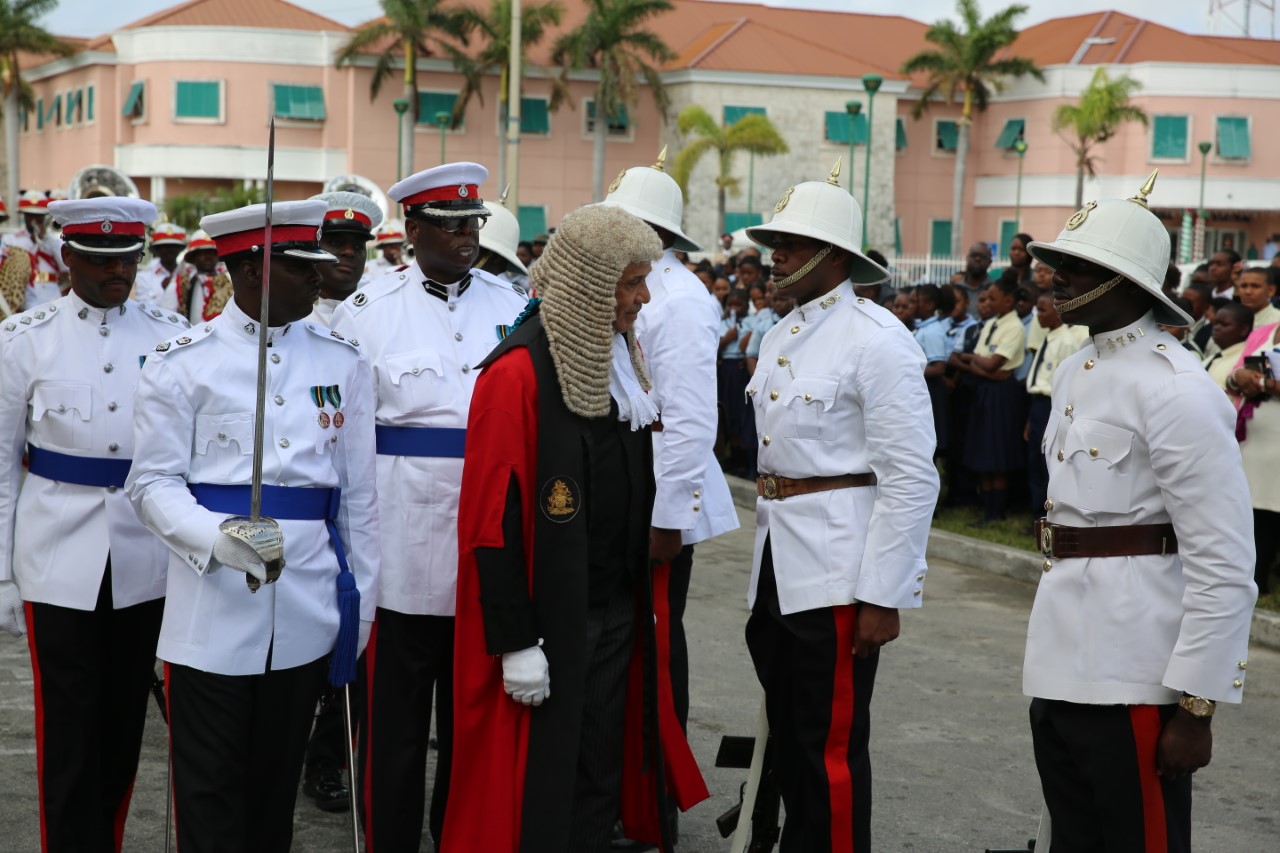


Prime Minister the Hon. Philip Davis delivered an address in Grand Bahama this evening where he outlined the government’s plans to create a new framework for this island including a review of the Hawksbill Creek Agreement.
Mr. Davis’s presentation is below in full.
Friends,
We meet tonight in a shipyard, and I chose this location with care. I thank the management and the men and women of this yard for welcoming us.
For every vessel that comes into this yard, the owner has a decision to make. Patch the hull, send her back to sea, and hope she holds. Or bring her into dry dock, take her down to the steel, overhaul her engines to ensure that she is again seaworthy.
Grand Bahama has been patched up for too long.
Rather than relying on another short-term fix, the time has come to choose which direction this island is going to take.
We are at a fork in the road, and need to decide which of the two paths we are going to take.
The first path is familiar, because we have walked it for decades. On that path, Grand Bahama – which has been patched up in the receding past, surveyed a couple of times decades ago, creaking under the stress on its aging bearings – Grand Bahama waits.
It waits for the next announcement. It waits for decisions taken in boardrooms, by people the voters of this island never chose. It waits for the year 2054, when the Hawksbill Creek Agreement finally runs its course.
Think about what that means for a child born in Freeport tonight. In 2054 she will be twenty-eight years old. On this first path, she spends her childhood, her school years and the start of her working life under an arrangement written for a colony 70 years before she was even born. An arrangement made before The Bahamas was even an independent sovereign state: fully recognised under international law, with a respected voice in the halls of the United Nations and the Commonwealth of Nations and a proud place on the world stage.
This child of Freeport, justifiably proud of her nation’s progress, is not allowed to have the same pride in her own home town. Because, at the age of 28, she will have seen, as she matured, that home town burdened with a system of administration and governance that never matured with her.
A system which has at its heart, a private company, whose management, like any company, owes its primary allegiance to its shareholders, and not to her or her fellow citizens.
Almost now uniquely in the modern world, this is a system of local government without fiscal or democratic accountability.
Are we to make this child of Freeport, born tonight, witness that same strange reality, and walk that same, strange path, until she is a grown woman? Or is it our responsibility to do better for her and choose a different path?
Well, my Friends:
The second path is harder.
It asks more of all of us.
It asks Government to lead and to listen. It asks investors to trust new rules.
It asks the Port Authority to accept a new role. And it asks every Grand Bahamian to take part.
Taken together, these things are not easy.
But once that path is laid, at the end of it will be an island that decides its own future, is governed under its own laws, and through a Government elected by its own people.
It is a path to political maturity for Freeport and Grand Bahama.
It is a path to sound government, conducted as part of a plural democracy, with fiscal and democratic accountability for the benefit of all our citizens.
Friends:
My Government has chosen the second path. Tonight I will tell you why we have done so, and how we will navigate it together.
Grand Bahama is a first-order priority for my Government. That priority reaches beyond any one hotel, any one terminal and any one airport. I will speak about all three tonight. Yet every one of them depends on the answer to a single question.
Who governs Grand Bahama, and in whose interest is Grand Bahama governed?
Every other question about this island flows from that one. Tonight I will answer it.
I do not approach that question as a stranger. I first came to Grand Bahama in 1974, as a young man starting my working life. I have seen this island busy and proud. I have seen it flattened by hurricanes, including Dorian. I have watched its young people leave on the morning flight.
Through all of it, my faith in this island has held strong.
So I speak to you tonight with the frankness that faith demands of a close friend.
I start with a simple truth.
You know me. You know Brave. I want to get this right, and I want to get it right with you. Having things stay the same is not on the table for me. I have no interest in a status quo which holds our people back and denies them participation in the democratic administration of their island. It does not work for Grand Bahama, so it does not work for me.
I come to the table with a menu. And it’s important that everyone understand what is on that menu.
The time for reform is very long overdue. And I want to negotiate the path forward. I am prepared to discuss the pace of reform. I am prepared to listen to anyone, whoever they are, who puts the interests of the people first.
But I am no longer prepared to negotiate as to whether Grand Bahama deserves a different future.
That is off the menu!
So let me first help you understand what is not on the menu. We will no longer serve two different standards of public accountability for government on one island.
A private veto over the future of Grand Bahama is also off the menu. Public power without proper safeguards against private conflicts is off the menu. And there is no table for those who want to wait until 2054 for any change.
The people of this island need certainty.
The people of Grand Bahama need progress.
So tonight, we set the compass towards certainty.
The present way of governing Freeport will come to an end.
This is my starting point.
It is non-negotiable.
‘Whether’ we change is settled. How we change is yours to shape.
I will make the case carefully and in full, as to the reasons behind my decision.
In 1955, the colonial Government of the day signed the Hawksbill Creek Agreement with a private company, the Grand Bahama Port Authority. It was a bold experiment. The company would build a port and a city in the pine forest. In return, it received generous concessions and a large share of the powers of government over that city.
For a time, the experiment delivered. The harbour was dredged, industry arrived, and hotels rose. Those achievements are real.
But an experiment must be judged by its results, and after seventy-one years the results are lacking.
In the 2022 census, Grand Bahama had 46,740 residents. In 2010 it had 51,368.
In twelve years, this island lost nine per cent of its people. That same census in 2022 found that nearly one home in five was empty.
Behind each of those numbers is a kitchen table where a family decided to leave. A son who found work in Florida. A daughter who moved to Nassau. Grandparents who now watch their grandchildren grow up on a cellphone screen.
Hurricanes explain part of that story. The world economy explains part of it. A structure that no longer fits the island explains the rest.
Today, a resident of Freeport lives under two systems at once. National law governs some parts of her life. A private company governs others, through its licences, approvals and bye-laws.
When a resident needs a permit or an answer, our child of Freeport cannot always tell who decides. A business in West End meets one set of rules. A business in Freeport meets another. East and West Grand Bahama are at the edge of decisions taken in the middle.
How long should Grand Bahama wait for that to change? Until 2054? Until the next hurricane? Until another generation has packed its bags?
Standing still has cost this island too much already. I will not ask Grand Bahama to pay that price any longer.
Reform takes time. Families should not have to wait for it. So while we reform how Grand Bahama is governed, we are building what Grand Bahamians can see and use.
Three priorities stand above the rest: the airport, the harbour and the Grand Lucayan Hotel.
Let’s start with the airport. In 2019, Dorian’s surge filled the old terminal to the roofline. After the storm, airport staff worked out of their own cars and processed passengers under tents. The staff kept this island connected when it needed it most. Grand Bahama, I think we owe them our thanks.
A new international terminal is now being designed, with provision for United States Customs pre-clearance. Its floor is designed to stand 23.5 feet above sea level, higher than Dorian’s surge and the hundred-year storm level used in the design. The old floor sat at 10.5 feet. This terminal is being designed for greater protection against flooding. There will also be a flood meditation plan alongside the design.
The Concept Design work is due to be completed at the end of this month. Construction is scheduled to commence before April 2027, with completion targeted for early 2029.
Meanwhile, thirteen airfield safety and repair packages, at a cost of about $8.6 million, are under way or being contracted now. Preparation work has begun.
Now let’s consider the harbour. MSC, which has operated in The Bahamas now for twenty-five years, has been approved to invest $400 million in a modern cruise terminal at Freeport Harbour.
Its wider Freeport programme has three parts: upgrades at the Old Harbour, a new terminal at Billy Cay and a beach club at Lucaya. Public consultation on Billy Cay and the rest of these works takes place on 2nd November.
At full build-out, the harbour could berth up to six of the largest cruise ships afloat. This will require the expansion of the entry to the harbour and MSC is in conversation with the owners of the land about this expansion. MSC expects more than 600 direct jobs and a payroll of more than $14 million a year.
On its own planning assumptions, the programme could bring up to 20,000 visitors a day, spending more than $300 million a year onshore.
Now the Grand Lucayan Hotel. For ten years, the heart of Lucaya has been largely dark. Most of the resort has been closed since Hurricane Matthew in 2016.
The Government of the day bought it in 2018, and the Bahamian people have carried it ever since. Two attempts to sell it have failed. The shops, the Straw Market and restaurants of Port Lucaya have felt every one of those years.
That is changing. Demolition has begun. Concord Wilshire is redeveloping the resort, and MSC, through CTL Maritime, will build its beach club on twenty acres of it.
It will be a beachfront destination with restaurants, bars, shops and vendor booths, a spa, pools and water sports, with separate areas for families and adults.
Site clearance for the beach club begins in December, and it is planned to open in November 2028, alongside the first phase of Billy Cay.
Around it, Concord Wilshire plans a second cruise resort with a Bahamian operator, a hotel and casino resort, a mega yacht marina and a championship golf course. On the developers’ projections, the beach club and the cruise resort together will draw more than one million guests a year.
That means customers for Port Lucaya again.
To the men and women who served the Grand Lucayan through its hardest years: this site is coming back to life, and I expect your experience to count when the jobs return.
My test for any investment is simple: who benefits?
MSC’s plans include market stalls and vendor booths for Bahamian artisans and straw vendors, and work for Bahamian tour operators, taxi drivers and excursion businesses. Twenty thousand visitors a day should mean twenty thousand chances for a Bahamian business.
Alongside the work on the airport and the renewal of our tourism product, my Government is making significant progress on the Freeport Health Campus. In September, construction was about 30 per cent complete, with the foundations and superstructure in place. The first phase is on target to open in 2027. The campus will expand access to modern healthcare for Grand Bahamians, and it will house a training academy for the nurses and health workers this island needs.
Friends, I want you to notice something about these projects.
MSC and Concord Wilshire are private companies, and they will earn a return. The airport is a public asset, answerable to the public. Private enterprise and public duty are working side by side, each doing its own job.
That is the balance I want for the whole of Grand Bahama.
I will return to this point.
Now let me speak about the Port Authority.
There has been an arbitration. There have been hard words on every side, some of them mine. The tribunal’s Award is public, and any questions still before it will be resolved there.
I do not go looking for fights, but neither have I ever been afraid of one.
Standing still is not an option.
Who governs Grand Bahama, and in whose interest is Grand Bahama governed?
I want an answer to this question that residents, licensees, investors and the Port Authority can all live with, and one that will last.
I would rather build this future with you than around you.
To the Port Authority, its shareholders and its staff: there is a seat for you at this table. Many of the Port Authority’s staff are Grand Bahamians. Their skills will be needed, and the transition must include those skills.
The Port Authority can have a strong and profitable future here, as a landowner, a developer, an investor and a partner.
To the licensees: your businesses are part of this island’s strength. The rights you hold lawfully will be identified, recorded and respected. You will have a full say in how any change is made.
And to the families who came here in the 1950s and 1960s and built a city out of pine forest: your work is part of the Bahamian story. We honour it, and we will build on it.
Meaningful consultation is how we will travel. Change is where we are going.
Now I come to the heart of what I came to say.
I want to be fair to everyone in this room. I respect the families who own the Port Authority. I respect its staff and its licensees. My argument concerns a structure.
I learned the meaning of public duty at home. My father was a firefighter, an ordinary man and my hero. A fire service answers every alarm. It goes to the big house and the small one, to the owner and the tenant. It asks one question: where is the fire? That is what public service is. It is a duty owed to everyone, on equal terms.
Private enterprise runs on a different logic, and so it should.
A company seeks a return for its owners. Its directors have fiduciary duties to the company. Commercial decisions properly take account of profit and loss. That is lawful and honourable.
But private interests and the public interest can live side by side. They do so in every successful economy in the world. They can do so here.
The trouble in Grand Bahama is the imbalance between the private and public interests.
For seventy-one years, a private company has held powers that, in the rest of The Bahamas, belong to the Government: who may do business, what may be built, how land is planned and what residents pay in fees and charges.
Here is the root of that imbalance. When private commercial interests sit alongside public powers, the same institution can face competing duties and functions.
The public needs a framework that separates those duties and functions, while making public decisions answerable to the public. That is democratic accountability.
But Freeport does not have that now, and it has not had it for decades. That is a structural conflict. It does not require us to question the motive behind every decision to see why the structure must change.
Think of the decisions that shape a city. A seawall that needs repair. A young entrepreneur who wants to compete with an established business. A family that needs a permit after a storm.
In each case, the public need is clear, but the private calculation may point the other way.
That is unfair to Grand Bahamians. It is unfair to the company as well. No board of directors should be asked to weigh its shareholders interests against a city. No private company should have to choose between its profit and the community in which it exists.
We have already begun to bring balance back to Grand Bahama. In May, my Government acquired the Grand Bahama Power Company. Grand Bahama is now in line with the rest of the country on electricity oversight and pricing.
Since June, more than 17,000 households and more than 1,500 small and medium-sized businesses have seen lower bills, with residential bills down by at least 35 per cent. No Grand Bahamian should pay more for power simply because of where they live.
Here’s a distinction that sits at the centre of all of this.
A company may own land. But authority over people belongs to the people, through the Government they elect. Ownership is a private right. But authority is a public trust.
The distinction between the two has been blurred in Freeport for seventy-one years.
Ask yourself a simple question. Would we accept this arrangement anywhere else in The Bahamas? Would the people of Nassau accept a private company deciding who may open a shop on Bay Street? Would Exuma accept it? Would Eleuthera accept it? Would Abaco? Would Cat Island?
Then why should Freeport?
There is a deeper principle at stake: sovereignty.
Just last month I stood in front of the United Nations General Assembly and argued passionately for the sovereignty of The Commonwealth of The Bahamas to be protected and respected.
If I am prepared to defend our sovereignty against foreign interests, I am certainly prepared to fight for our sovereignty at home.
In a free country, public power comes from the people. It is exercised by those the people elect. It answers to the people through Parliament, the courts and the ballot box.
Accountability is the price of power. A Government pays it at every election. Any body that exercises public power over Bahamians must pay it too, by answering to the public for how that power is used.
Now consider when the Freeport arrangement was made. In 1955, no Bahamian woman could vote. Majority rule was twelve years away. Independence was eighteen years away.
The arrangement that still shapes daily life in Freeport was settled in a colony, by a colonial government, before Bahamians governed themselves.
Since then, we have won majority rule and Independence. We have written our own Constitution. We have chosen our governments peacefully, election after election.
Yet in our second city, powers that belong to the Bahamian people still rest on an arrangement from the colonial age.
What does Independence mean, if it stops at the boundaries of the Port Area? Whose island is this?
It belongs to the people who live on it, and to the nation of which they are part.
In 2026, it is incomprehensible that any part of this Commonwealth, special economic zone or not, should be governed outside the free will of the Bahamian people.
Let us call it what it is. It is colonial in origin. It is colonial in character. It is unacceptable, and it has out-lived its time.
An arrangement born in a colony must be brought into line with the needs and demands of a free nation.
I will not apologise for saying so.
This is a question for every Bahamian, wherever you live. What happens in our second city helps to shape the whole nation, and the whole nation has a stake in getting it right.
So let me state the principles that will guide every step we take.
Public power belongs to the public. No private interest will stand between Grand Bahama and its future. No private institution will hold a veto over the development of this island.
There is a second half to that principle, and I hold it just as firmly.
We will correct the imbalance lawfully, through Parliament and the other legal steps that are required. Reform must properly address vested interests, contracts and protection of investments.
Nothing will be done retrospectively.
Businesses will earn. Government will govern. Each will do its own job, and each will be stronger for it.
To our friends from the United States, from China, the United Kingdom and all other nations, and to every investor watching: The Bahamas welcomes every partner who invests under Bahamian law. That law will be clear and published, with transparent decisions and access to lawful procedures for everyone.
Equal public accountability does not require identical incentives in every place. Certainty is the strongest incentive any country can offer.
Tonight, my Government sets out its proposed way forward. The details are in a Green Paper titled, “Grand Bahama: A Framework for Stability and Growth.” We will publish it online at http://www.gbframework.com, with a short summary, before the formal consultation opens.
Let me tell you how we built it, because the method is part of the message.
We took our time. We studied the Hawksbill Creek Agreement and the instruments that followed it. We studied the tribunal’s Award and the economic record of the whole island. A policy team prepared the strategy. A working group tested it. Cabinet has examined it in preparation for its publication.
The Green Paper begins with an objective, and that objective is settled. Public administration and regulation on Grand Bahama will be accountable, open and consistent across the whole island, whether you live inside the Port Area or outside it.
Every resident and every business should know who holds governmental, regulatory and administrative authority. They should know how decisions are made, and where to go for an answer or a remedy.
But this is not just a proposal to rearrange institutions. It is an island-wide development strategy, connecting Freeport, East Grand Bahama, West Grand Bahama and the surrounding cays into one economy.
To reach that objective, we propose three connected reforms which will serve a common plan: to connect our ports and airport, our industry and tourism, our technology and blue economy, with the roads, reliable utilities, skills and resilient communities that make growth possible.
The projects I described tonight must become foundations for opportunity across the island.
The first reform is a Government-led Grand Bahama Development Council. It will give the whole island a standing voice in its own development, bringing Government together with local government, licensees, labour, business, communities and young people.
Its purpose goes beyond merely offering advice. It will coordinate strategic development initiatives, monitor implementation, identify institutional obstacles and report progress to Government.
When a project stalls between agencies, someone must be responsible for bringing the problem forward and tracking its resolution.
Consultation will shape the Council’s permanent form, membership, accountability and any additional powers requiring legislation. It would not take over the lawful decisions of regulators.
The second reform is a comprehensive review of the Hawksbill Creek Agreement, directed by the Attorney General.
This will not be yet another review that results in maintaining the status quo. We will amend the Hawksbill Creek Agreement and create the balance Grand Bahama deserves.
The Agreement, however, is not simply one statute that can be removed with a stroke of a pen. It includes contractual and statutory arrangements, supplemental agreements, concessions, and other legal relationships.
We will examine them function by function: licensing, planning, building control, environmental protection, utilities, customs and immigration arrangements, roads, drainage and other public services and make the necessary changes to them.
For each function, we must establish who has the legal power, who does the work, who pays, and set out what standard of delivery the public can expect. Existing licences, approvals, concessions and other lawful interests will be identified and their treatment addressed.
The arrangements of the Hawksbill Creek Agreement will be modernized for an independent nation, amended to address the colonial-era irrelevance, and ensure that East and West Grand Bahama and surrounding cays are included.
The third reform is a modern legislative framework for the whole of Grand Bahama, including a Grand Bahama Development Act.
Our proposed direction is a comprehensive successor framework. Getting there will require negotiated changes, amendments, targeted repeals, replacement provisions and consequential legislation, while preserving lawful commercial arrangements where appropriate.
Consultation and detailed legal analysis will guide the precise measures, the allocation of public functions and the transitional period.
The new framework should put island-wide planning, government-led development coordination and public accountability into law.
It is not intended that the Grand Bahama Development Act simply be a replacement for the Hawksbill Creek Agreement; it is more than that.
It is the tool that will lift all of Grand Bahama to equal economic opportunity.
Why will this work where earlier efforts stalled? Because the three reforms are designed to work together.
A Council must have a clear job. A law must say who does what. And the strategy must reach the people it is meant to serve.
We propose a framework of island-wide concessions, including the possibility of offering enhanced concessions outside the Port Area, so that growth reaches East and West Grand Bahama and surrounding cays sooner. The rates, duration and conditions will be informed by consultation and fiscal analysis. Those concessions must serve Bahamian employment, training, local suppliers and enterprise. A young Bahamian must be able to see a route into a skilled job, a contract or a business of their own. We will measure those benefits and report them publicly.
Change will be orderly. Services must continue through a carefully managed transition, with responsibilities, staff, funding and systems in place before functions move.
Residents must know who to call, and businesses must know where their applications stand.
Freeport will remain the commercial, maritime and industrial heart of this island. Our aim is for its success to reach every settlement, from Sweetings Cay to West End.
The Green Paper is a living document. Its questions are real questions for which we seek answers that best serve the whole of Grand Bahama.
We will listen to evidence about the institutions, legal measures, concessions and safeguards we propose, including evidence that challenges our assumptions.
The Green Paper is our first word. Grand Bahamians will help shape the last.
One island. One economy. One framework.
So where do we go from here?
The Green Paper is online at http://www.gbframework.com. Read it. Share it. Question it. Debate it. Argue with it.
Before the consultation begins, we will publish the times and dates for townhall meetings and the ways to submit your views.
On 1st November, the formal consultation opens. It runs for six months, to 30 April 2027. There will be public meetings, as mentioned, in Freeport, in East Grand Bahama and in West Grand Bahama, alongside sector discussions and written submissions.
Those who need help to take part will receive it.
A small Cabinet Subcommittee on Grand Bahama Reform, chaired by my designated senior Minister, will oversee progress, address policy questions and bring recommendations to Cabinet.
A separate professional secretariat will administer the consultation, keep a faithful record and support the Subcommittee and Development Council.
Consultation administration will not confer licensing or regulatory powers.
This is the timetable, and I ask you to hold me to it.
After consultation closes, the full record and recommendations will go to Cabinet for consideration. Our target is a White Paper on 1 July 2027, setting out our decisions, the reasons for them and how the views we heard shaped the result. We aim to complete draft legislation by 31 December 2027 and bring it forward for passage in the first quarter of 2028. That will support allocation for the new framework in the 2028/2029 Budget.
Six months is time well spent if it means we get this right. We will use the opening phase to explain the proposals, the months that follow to work with you to examine the choices, and the closing phase to draw the issues together. Every timely submission will be considered before final recommendations are made.
Friends:
I want us to build a consensus. I want meaningful participation. I am asking every resident, every worker, every licensee and every investor to take part, because a reform built with the people will outlast any government that begins it. We will explain how we have dealt with substantive alternatives, including where we disagree.
I know that some will be troubled by what I have said tonight.
If anyone is offended that this Government has acted in the best interest of the Bahamian people, I am sorry that you are offended. But on this, we will have to agree to disagree.
Because on this point, there is no alternative.
A colonial system that has outlived its purpose, and belongs to another age, must give way to a modern framework.
We pledge a change to the Hawksbill Creek Agreement, a change that doesn’t focus activity in one area. My Government will pursue that change lawfully, and put in its place a framework that belongs to the people of this entire island.
Now is the time to finish the work that Independence began.
And so let me return to where I began.
There are two paths before Grand Bahama. One leads back to waiting. The other leads to an island that governs itself, under its own laws, in the interest of its own people.
Tonight my Government has chosen. Tomorrow the work begins.
At the start, I asked a question. Who governs Grand Bahama, and in whose interest is it governed?
Here is my answer.
The people of The Bahamas govern Grand Bahama.
They do so through the Government they elect. And in the interest of the people who live here.
Think again of the child born in Freeport tonight. In the year 2054, when she is twenty-eight years old, , I want her to read about this evening.
I want her to read that on 21st October 2026, in a shipyard in Freeport, her country decided that no part of The Bahamas would be governed outside the will of its people. I want her to know that her island refused to wait for a calendar to set it free.
Friends, there comes a time when a mighty vessel can no longer just be patched up. The work may be hard, difficult decisions may have to be made, but the status quo will have to change.
But we shall no longer leave it for someone else to fix. The waiting is over.
This work is ours. This moment is ours.
I say especially to the young people of this island: you have a unique opportunity to help shape the future of this island.
Make sure your views are known, make sure your voices are heard.
Work with us to give Grand Bahama its best future.
One island. One economy. One framework. Under one sovereign, democratic nation.
Thank you. May God bless Grand Bahama, and may God bless the Commonwealth of The Bahamas.


